Lab note
Sediment vs Carbon Whole House Filters: What Each Removes
A sediment filter is a strainer: it catches particles by size — Nebraska Extension lists “sand, silt, loose scale, clay, or organic material” — and it is rated in microns. A carbon filter works on some things that are dissolved: Nebraska Extension says activated carbon “can effectively reduce certain organic compounds and chlorine,” along with “harmless taste- and odor-causing compounds.” Neither one removes hardness. Gritty or cloudy water points to sediment; a chlorine taste or smell points to carbon; when you have both problems, the sediment stage goes first.
The difference in one table
| Sediment filter | Carbon filter | |
|---|---|---|
| How it works | Traps suspended particles on or inside the filter medium (Nebraska G1492) | Holds certain compounds on the surface of carbon particles — adsorption (Nebraska G1489) |
| What the source says it takes out | “sand, silt, loose scale, clay, or organic material”; also “insoluble (not dissolvable) or suspended iron and manganese” | Chlorine, chloramines, “some disinfection byproducts,” certain organic compounds, taste- and odor-causing compounds |
| What the source says it doesn’t | Does “not effectively remove dissolved organic or inorganic material”; “not generally recommended for removing microbial contaminants” | Will not remove “microbial contaminants (such as bacteria and viruses), calcium and magnesium (hard water minerals), fluoride, nitrate” |
| How it’s rated | Microns, “nominal” or “absolute” | Capacity in gallons and flow rate; claims under NSF/ANSI 42 (taste, odor) or 53 (health) |
| Hardness (calcium, magnesium) | No — they are dissolved | No |
| When to replace | When “a noticeable drop in water flow” occurs | At the rated gallons or the maker’s interval — pressure drop is not a reliable sign |
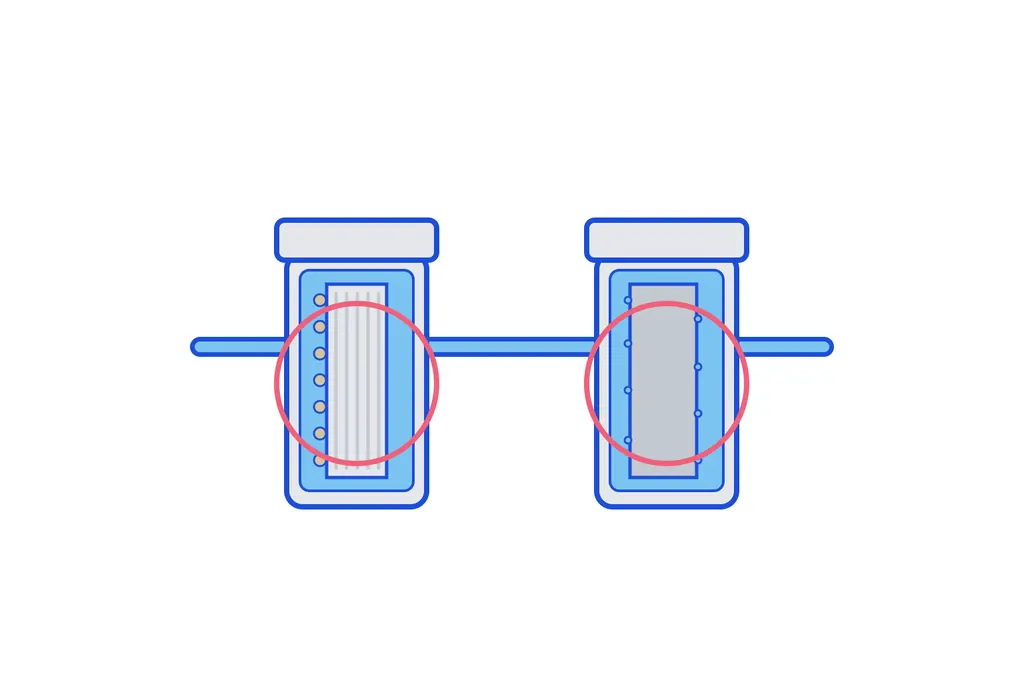
NSF’s filtration page lists the claims a filter can carry under NSF/ANSI 42 (aesthetic effects): “Chlorine, taste and odor, chloramine, particulate, iron, manganese, zinc, and total dissolved solids (TDS).” Health-related claims, such as lead, fall under NSF/ANSI 53. A filter is only proven for the claims on its certification listing, not for everything its type can do.
What a sediment filter does
Nebraska Extension says sediment filters are used after chlorination or aeration that turn dissolved iron, manganese or hydrogen sulfide into particles, and “as pretreatment” for carbon filters and reverse osmosis. Very fine “flour sand” and clay can slip through a typical cartridge; Nebraska points to microfiltration for those. Its guide is about cartridge filters: for a whole house with a lot of sediment, it says “POE media filters or multimedia filters often are used” adding: “Consult a water treatment professional for guidance on these filters.”
What a carbon filter does
How much carbon removes depends on the carbon, the compound, the amount of carbon and contact time — Nebraska notes that “greater contact time can allow for greater adsorption.” For a rotten-egg smell from a well, Penn State Extension says activated carbon “may be effective” below about 1.0 mg/L of hydrogen sulfide and that a whole-house unit needs “usually 1.0 to 1.5 cubic feet of carbon”; higher levels call for other treatment (see sulfur smell in well water).
Carbon has a limit. When it is full, Nebraska Extension warns, contaminants can pass through, and “the contaminant concentration in the ‘treated’ water may actually be higher than in the untreated water.” That is why the replacement schedule matters more for carbon than for sediment.
When you need both
Nebraska Extension’s rule: “A sediment or particulate filter installed ahead of any AC filter will prolong the life of the AC filtration unit,” because sediment “can easily and quickly clog the pores.”
Some cartridges combine the two. Pentair lists its Pentek RFC-BB (10-inch) as “Reduces: Chlorine Taste & Odor, Medium-Fine Sediment,” 25 microns, 50,000 gallons, 2 gpm, and says it is “Tested and Certified by NSF International to NSF/ANSI Standard 42.” The maker’s page doesn’t say which claims that certification covers, so check the NSF listing for the model before you rely on it.
If your water is also hard, a filter won’t fix that — see does a water filter soften hard water?.
Micron ratings
Nebraska Extension explains the number this way: a 10-micron filter “would trap contaminants 10 microns in diameter or larger.” For scale, it gives silt as roughly 2.0–50 microns, sand as 50 microns to 2 millimeters and clay as 0.2–2.0 microns. Its warning: “many filters are only rated for particles 20 microns in diameter or larger” and may not catch some silt.
- Nominal should trap “approximately 85 percent” of particles at the rated size; absolute, “approximately 99.9 percent” (Nebraska).
- Smaller isn’t automatically better. “In general, the largest rating size that will remove the intended contaminants will require the least maintenance,” Nebraska says; a too-fine cartridge can clog fast.
For example, Pentair’s spec sheet lists the R50-BB pleated polyester cartridge at 50 microns nominal — a rating the sheet notes is based on the maker’s internal testing.
Replacement intervals and cost
Sediment: Nebraska Extension says to clean or replace the cartridge “when a noticeable drop in water flow through the filter occurs,” and that gallon ratings are hard to rely on because the amount of dirt in water varies.
Carbon: go by the rated gallons and the maker’s interval — Pentair says to replace the RFC-BB “every 6-12 months… or when you notice a drop in water pressure or quality.” Nebraska Extension adds that a pressure drop “may or may not result from the filter reaching adsorption capacity,” and, citing product tests, that “it may be safer to replace the filter more often than recommended by the manufacturer.”
What it costs, from HomeGuide’s well water filtration guide (Apr 24, 2026), which prices the two stages separately:
| Sediment | Carbon (whole-house) | |
|---|---|---|
| Equipment | $50 – $300 | $300 – $1,000 |
| Installed | $150 – $500 | $600 – $2,000 |
| Replacement cartridge | $5 – $30, every 1 to 3 months | $20 – $80, every 6 to 12 months |
For two real cartridges, DiscountFilterStore lists the Pentek R50-BB sediment cartridge at $22.35 and the RFC-BB sediment-plus-carbon cartridge at $58.35 (10-inch, regular prices, checked Nov 1, 2026). Full budgets are on whole house water filter cost, and cartridge routines on whole house water filter maintenance.
What to ask before you buy
- What micron rating, and is it nominal or absolute?
- What flow rate does it deliver at my water pressure? (Nebraska Extension advises checking this before you buy.)
- Which NSF/ANSI standard is it certified to, and for which claims — material safety only, or chlorine, taste and odor, particulate?
- How many gallons is the carbon rated for, and what does a replacement cartridge cost?
- Who installs it? A licensed plumber; ask whether your town requires a permit.
If you are filtering for something that affects health rather than taste, test first — your utility’s annual water quality report for city water, a state-certified lab for a well — and choose a model certified for that contaminant. This site doesn’t give medical advice. For health questions about your water, ask your state or local health department. Not sure what your water needs? Run the Water Check.
Tool
Have a hardness number or a well test? Water Check turns it into what to install, the size and a price range.
Open Water CheckAn AI tool drew the illustrations on this page as simple diagrams. They are not photographs of real homes, water systems, products or people.
Sources
- Nebraska Extension — G1492, Drinking Water Treatment: Sediment Filtration (Dvorak & Skipton, revised Dec 2013)
- Nebraska Extension — G1489, Drinking Water Treatment: Activated Carbon Filtration (Dvorak & Skipton, revised Nov 2013)
- NSF — NSF/ANSI 42, 53 and 401: Filtration Systems Standards (Dec 16, 2025)
- NSF — NSF Standards for Water Treatment Systems (consumer page, accessed Nov 1, 2026)
- Penn State Extension — Hydrogen Sulfide (Rotten Egg Odor) in Water Wells (updated Dec 10, 2024)
- Pentair — Pentek R Series pleated polyester cartridges, spec sheet 310066-S Rev D (2015, Spanish-language edition), pp. 1–2
- Pentair — Pentek RFC-BB product page (checked Nov 1, 2026)
- HomeGuide — How Much Does a Well Water Filtration System Cost? (Tom Grupa, Apr 24, 2026)
- DiscountFilterStore — Pentek R50-BB and RFC-BB cartridge listings (regular prices, checked Nov 1, 2026)
Updated 2026-11-01