Lab note
Does a Water Filter Soften Hard Water?
Usually, no. The usual whole-house filters — sediment and carbon — don’t remove the calcium and magnesium that make water hard. Nebraska Extension lists “calcium and magnesium (hard water minerals)” among the things activated carbon will not remove, and says sediment filters don’t remove dissolved material. Removing hardness takes a water softener (ion exchange). Reverse osmosis and distillation also remove hardness, but Nebraska Extension (G2275) notes they “are generally not applied to whole house treatment.” So the practical answer for a whole house: a softener for hardness, a filter for everything else, and sometimes both.
Softener or filter: which problem do you have?
Start from what you see, then confirm it with a test. The middle column comes from EPA’s guidance for private well owners on what to test for; it may help with city water too.
| What you notice | What EPA suggests testing for | What usually treats it | More |
|---|---|---|---|
| “Scaly residues, soaps don’t lather” | Hardness | Water softener | what size softener |
| Sand, grit in the water | — (Nebraska: suspended “sand, silt, loose scale, clay”) | Sediment filter | sediment vs carbon |
| “Water appears cloudy, frothy or colored” | Color, detergents | Ask the lab what the result points to | well water testing cost |
| Chlorine taste or smell (city water) | — | Carbon filter | sediment vs carbon |
| “Stained plumbing fixtures, laundry” | Iron, copper, manganese | Depends on the level: softener, iron filter, or oxidation + filtration | iron filter for well water |
| “Objectionable taste or smell” | Hydrogen sulfide, corrosion, metals | Depends on the level | sulfur smell in well water |
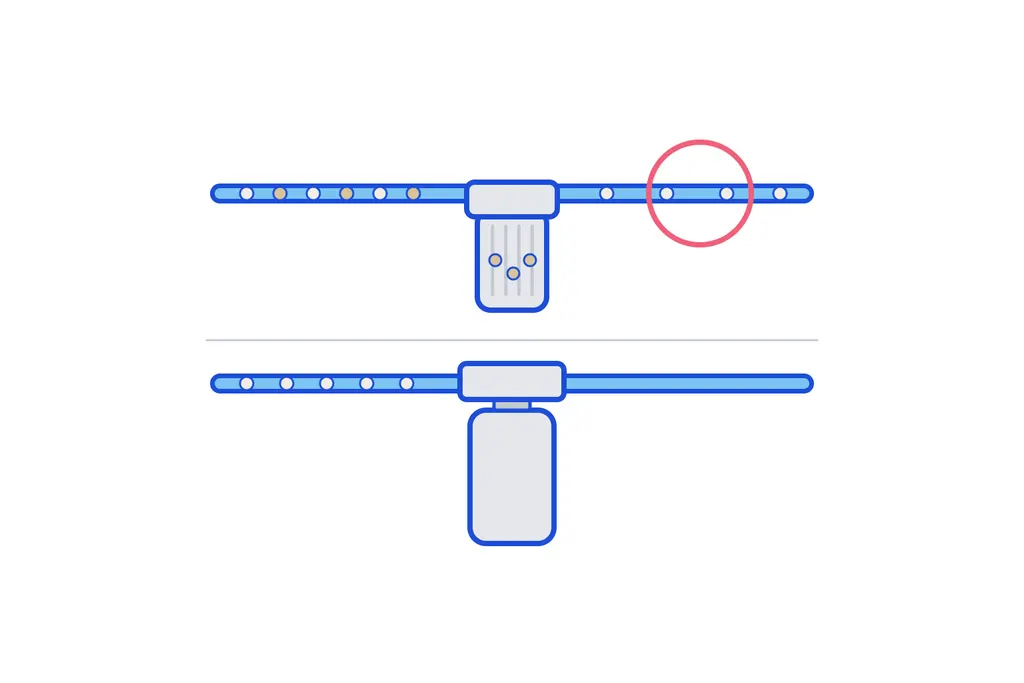
NSF keeps the two jobs under different standards. Filters are certified under NSF/ANSI 42 (aesthetic impurities “such as chlorine and taste/odor”) or NSF/ANSI 53 (a contaminant “with a health effect”). Softeners are certified under NSF/ANSI 44, for units that use “a cation exchange resin that is regenerated with sodium or potassium chloride.”
What a water softener does and doesn’t remove
A softener trades the calcium and magnesium in your water for sodium (or potassium) on a resin bed, then flushes the hardness out with brine. Penn State Extension puts its scope plainly: “water softening simply removes hardness minerals,” and softeners “will not necessarily remove any of the more serious drinking water contamination problems.”
Nebraska Extension lists what softening does not remove: “bacteria, hydrogen sulfide, silt or sand, lead, nitrate, pesticides, and many other organic and inorganic compounds.”
Iron is the overlap, and the sources set different limits:
| Source | What it says about softeners and iron |
|---|---|
| Nebraska Extension (G1491) | Softeners “may also remove as much as 5-10 ppm” of iron and manganese — check the manufacturer’s rating |
| Penn State Extension | Softeners are “generally only recommended” when pH is above 6.7, hardness is 3–20 gpg and dissolved iron is “less than 5 mg/L”; oxidized iron “will foul the softener resin” |
Types of whole-house treatment, and whether they soften
| Treatment | Removes hardness? | What the source says |
|---|---|---|
| Sediment filter | No | Doesn’t “effectively remove dissolved organic or inorganic material” (Nebraska G1492) |
| Activated carbon | No | Won’t remove “calcium and magnesium (hard water minerals)” (Nebraska G1489) |
| Ion-exchange softener | Yes | Can remove “nearly all calcium and magnesium” (Nebraska G1491) |
| Reverse osmosis | Yes | Calcium and magnesium are on Nebraska’s list of what RO removes, but “most RO systems are POU systems placed under the sink,” and whole-house units “are more costly to purchase, install and operate” (G1490) |
| Salt-free conditioner | No | These “do not remove the hardness from the water, but instead change the form of the hardness” (Nebraska G2275) — see salt-free water softeners |
| Iron filter (greensand, birm, oxidation + filtration) | No | Penn State Extension describes these for iron and manganese, not hardness |
When you need both, and in what order
You need both when the test shows hardness plus something a softener doesn’t handle: sediment, chlorine taste, high or oxidized iron, hydrogen sulfide. The order the sources describe:
- Sediment first. The Minnesota Department of Health says cloudy water can clog softener resin and “adding a sediment filter before the softener could also help.” Nebraska Extension says a sediment filter ahead of a carbon filter “will prolong the life” of the carbon.
- Iron or sulfur treatment before the softener when it’s needed. Penn State Extension: “If oxidized iron and/or manganese are present in the raw water, filtration should be used for removal.”
- Softener.
- Reverse osmosis at the kitchen tap, after the softener, if you add one. Nebraska Extension: “For relatively hard water, pretreatment of the water by a softener can increase the life of the membrane.”
Where a whole-house carbon filter sits relative to the softener, the sources we read don’t say; ask the maker of each unit what they require.
On cost, the two jobs are priced separately:
| System | Typical range | Source |
|---|---|---|
| Water softener, installed | $1,100–$3,000 (national average $2,500) | Fixr, Jan 2025 |
| Whole-house carbon, mineral and sediment filters, installed | $850–$1,400 (HomeGuide’s higher whole-house figures, up to $5,400, add UV and a softener) | HomeGuide, Sept 2025 |
| “Full water treatment system” (softener plus filter), installed | $2,100–$3,300 | Fixr, Jan 2025 |
Details: water softener cost and whole house water filter cost.
Start with a water test
Buying equipment before you know the numbers is how people end up with the wrong system. Penn State Extension advises an independent lab test for hardness because, although many dealers offer free testing, “an independent lab test is not expensive and will protect you from being oversold.”
- City water: your utility must send its annual water quality report (Consumer Confidence Report) “each year by July 1,” EPA says. Look for hardness, and call the utility if it isn’t listed.
- Private well: EPA advises testing “annually for total coliform bacteria, nitrates, total dissolved solids, and pH levels,” and using only “laboratories that are certified to do drinking water testing.” If a softener is planned, EPA’s list adds manganese and iron.
Got a hardness number? The Water Check turns it into a softener size and tells you which other results change the plan.
Have the system installed by a licensed plumber, and ask whether your town requires a permit. This site doesn’t give medical advice. For health questions about your water, ask your state or local health department.
Tool
Have a hardness number or a well test? Water Check turns it into what to install, the size and a price range.
Open Water CheckAn AI tool drew the illustrations on this page as simple diagrams. They are not photographs of real homes, water systems, products or people.
Sources
- Nebraska Extension — G1489, Drinking Water Treatment: Activated Carbon Filtration (revised Nov 2013)
- Nebraska Extension — G1492, Drinking Water Treatment: Sediment Filtration (revised Dec 2013)
- Nebraska Extension — G1491, Drinking Water Treatment: Water Softening (Ion Exchange) (revised Sept 2014)
- Nebraska Extension — G1490, Drinking Water Treatment: Reverse Osmosis (revised Sept 2014)
- Nebraska Extension — G2275, Drinking Water Treatment: Salt-Free Water 'Softener' Options (Dec 2025), pp. 1–2
- Penn State Extension — Water Softening (updated Sep 8, 2025)
- Penn State Extension — Iron and Manganese in Private Water Systems (updated May 29, 2025)
- Minnesota Department of Health — Home Water Softening FAQ (last updated Oct 3, 2022)
- NSF — NSF Standards for Water Treatment Systems (consumer page, accessed Nov 1, 2026)
- U.S. EPA — Protect Your Home's Water: private wells, testing (last updated Feb 26, 2026)
- U.S. EPA — CCR Information for Consumers (last updated Nov 21, 2025)
- Fixr — Water Softener Installation Cost (updated Jan 31, 2025)
- HomeGuide — How Much Does a Home Water Filtration System Cost? (Sarah Noel, Sept 17, 2025)
Updated 2026-11-01