Lab note
Whole House Water Filter Maintenance: When to Change Filters
Change whole-house filter cartridges on the schedule in your system’s manual, and sooner if the pressure gauges show the filter is clogging. As one example, Applied Membranes says its whole-house cartridges “are designed to run for approximately 6 months (or their rated gallons),” adds that “the first sediment filter may need to be changed more frequently than the rest,” depending on your water, and recommends service when the pressure drop rises “greater than 10 psid above the initial reading” (psid is the difference between the in and out gauges, so service comes at about 10 psi more than the difference you wrote down at startup). HomeGuide’s cost guides put cartridge intervals at 1 to 3 months for sediment and 6 to 12 months for carbon on well systems. In money, HomeGuide puts whole-house filter upkeep at $15 to $250 a year before labor.
How often to change filters
Intervals depend on the filter, on how dirty the incoming water is, and on how much water the house uses. Two sources, side by side:
| Filter | HomeGuide well water guide (Apr 2026) | Applied Membranes manual, its own cartridges |
|---|---|---|
| Sediment cartridge | every 1 to 3 months, $5 – $30 each | 3 – 6 months |
| Carbon cartridge | every 6 to 12 months, $20 – $80 each | standard carbon: 3 – 6 months (10”) or 6 months (20”); HP carbon: 120,000 gallons (10”) or 240,000 gallons (20”) |
| Carbon media in a tank | every 3 to 5 years, $150 – $400 | — |
| Iron filter media (tank) | every 5 to 10 years, $200 – $600 | — |
| Iron cartridge (a different product) | — | 30,000 gallons (10”) or 50,000 gallons (20”) at 3 ppm iron |
| UV lamp | annually, $50 – $150 | — |
For filters without an indicator light, the U.S. EPA’s guidance on maintaining lead-reducing filters says “you’ll need to track the days (or gallons used) after installing a new cartridge and set your own reminder.”
The Minnesota Department of Health adds that the schedule is not optional: “All water treatment units require regular maintenance to work properly,” and “In some cases, unmaintained units can make water quality worse and can make you sick.”
Signs a filter needs changing
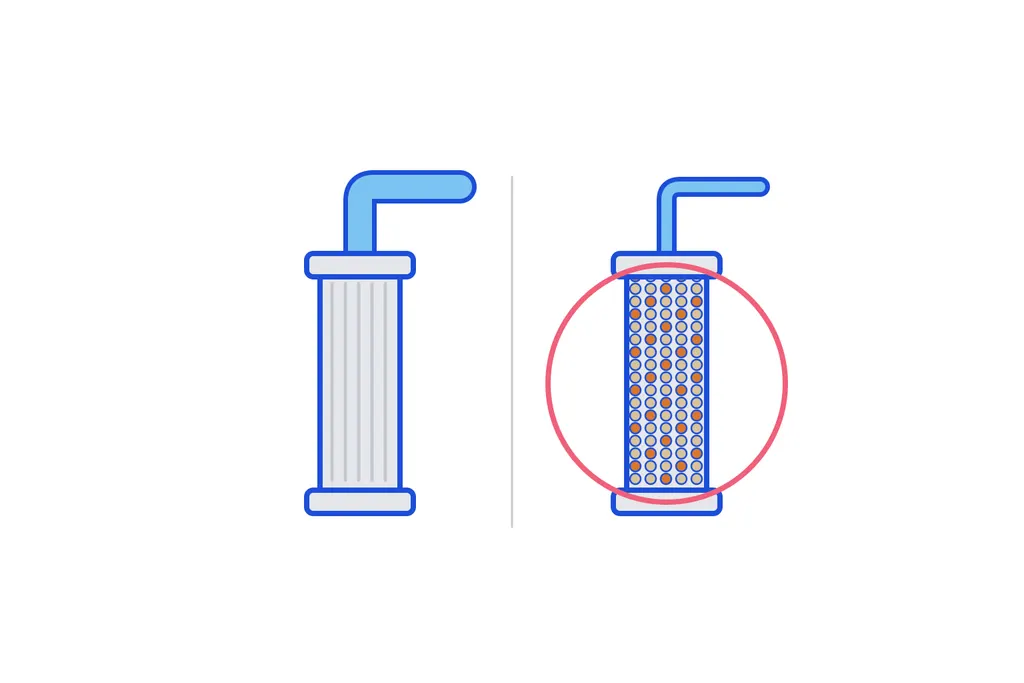
- The pressure gauges (if your system has them) show a bigger gap between inlet and outlet than on day one. See the next section.
- Lower flow at showers and faucets across the house. HomeGuide notes that a system itself causes some loss: “Some pressure drop is normal, typically 2 to 10 PSI per system.” A drop beyond what you had after installation is the sign to check the filters.
- The date or gallons on the manual’s schedule have passed, even if the water looks fine.
For carbon, waiting too long has a cost beyond flow. The Minnesota Department of Health warns that “Harmful bacteria can grow if you do not regularly maintain and replace the filter according to the instructions. If the filter is not replaced according to the instructions, it can become saturated and begin to release contaminants into the water.”
Pressure drop: reading the gauges
Some cartridge systems come with a pressure gauge before and after the filters; the Applied Membranes systems do. Its manual asks owners to write down both readings at startup. Its example: 65 psi in and 60 psi out is a 5 psi drop. Six months later the readings are 65 and 50, a 15 psi drop. “Pressure drop has increased by 10 psi from installation; service is recommended.”
The store page and the manual don’t say the same thing. Water Anywhere’s listing for the same system says to “Replace the filters when the pressure drop reaches 25 psi or higher.” The manual’s rule (10 psi above your starting reading) calls for a change sooner. When two documents from the same seller differ, follow the manual that came with your unit, or ask the maker.
Media tanks vs cartridges
Not every whole-house filter uses cartridges. Some use a tank of loose media:
- Cartridges are swapped whole, every few months to a year (see the table above).
- Backwashing tanks clean themselves on a schedule and send the rinse water to a drain. HomeGuide says carbon tank systems with backwashing “last longer between media changes (typically three to five years) compared to cartridge-style carbon filters that need replacement every six to twelve months.” The Minnesota Department of Health lists maintenance for a point-of-entry carbon system as “Extra water to backwash or adding a disinfectant to kill bacterial growth. Replacement of the filter.”
- Some upflow tanks don’t backwash. The listing for the Tier1 UP-1054-GACC says that system “does not produce any waste-water from backwashing or drainage” and that its media “lasts 450,000 gallons for chlorine and 450,000 gallons for chloramines or around 8-9 years,” after which the media is replaced, not the tank. That is the seller’s estimate for that model.
If you’re still choosing, see sediment vs carbon whole house filters.
Who should change the filters
Follow your system’s manual, or have a plumber or water treatment company do it; this site doesn’t give the steps. If a housing leaks after a change, call a licensed plumber.
The CDC adds two precautions: “Wear gloves while you change filters and wash your hands afterward to avoid getting sick,” and “If you have a weakened immune system, avoid changing water filters yourself.” This site doesn’t give medical advice. For health questions about your water, ask your state or local health department.
Yearly cost
| Source | What it covers | Cost |
|---|---|---|
| HomeGuide water filtration guide | whole-house filter upkeep, no labor | $15 – $250 a year (its table: $150 – $250 for replacement filters) |
| HomeGuide water filtration guide | technician labor per visit | $65 – $180 extra |
| HomeGuide well water guide | all well treatment equipment | $100 – $500 a year |
| Water Anywhere, Nov 1, 2026 | RFK-220BB-5C filter pack for the FA-220BB-5C-1 (1 sediment + 1 carbon) | $110.24 per pack |
By our arithmetic, two packs a year at the manual’s “approximately 6 months” come to about $220 in filters, before any labor. The carbon block in this pack is rated by gallons (240,000), so it may last longer than six months; the sediment filter (3–6 months in the manual) may need changing sooner. HomeGuide’s well range is wider because it covers every stage a well may have, from sediment cartridges to softener salt and UV lamps.
For what the system and installation cost up front, see whole house water filter cost.
Tool
Have a hardness number or a well test? Water Check turns it into what to install, the size and a price range.
Open Water CheckAn AI tool drew the illustrations on this page as simple diagrams. They are not photographs of real homes, water systems, products or people.
Sources
- Applied Membranes — Whole House Water Filter Installation & Service Manual (Doc FA-MAN, rev. 06092021), pp. 7, 9–10
- Water Anywhere — Applied Membranes FA-220BB-5C-1 whole house filter, product page (checked Nov 1, 2026)
- Water Anywhere — Replacement Filter Pack RFK-220BB-5C, product page (price checked Nov 1, 2026)
- HomeGuide — How Much Does a Well Water Filtration System Cost? (Tom Grupa, Apr 24, 2026)
- HomeGuide — How Much Does a Home Water Filtration System Cost? (Sarah Noel, Sept 17, 2025)
- Minnesota Department of Health — Home Water Treatment (updated Aug 15, 2024)
- Minnesota Department of Health — Home Water Treatment (PDF, rev. 3/29/2024), p. 5 (carbon filter row)
- CDC — About Choosing Home Water Filters (Apr 10, 2024)
- U.S. EPA — Learn How to Maintain Your Water Filter (PDF, Aug 2025), p. 1
- DiscountFilterStore — Tier1 UP-1054-GACC whole house catalytic carbon system, product page (checked Nov 1, 2026)
Updated 2026-11-01