Lab note
How to Test Water Hardness
You can get your water hardness number four ways. On city water, start with the free number in your utility’s annual water quality report. At home, a test strip gives a rough range in minutes, and a drop-count titration kit gives a number to about 1 grain per gallon. For a number you’ll spend money on, send a sample to a certified lab. The Minnesota Department of Health (MDH) puts it simply: “You can measure the hardness of your water using a test kit or an independent laboratory.” Nebraska Extension adds a caution about home tests: “While some may provide accurate and reliable measurements from which decisions can be made, others may not. Greater reliability and accuracy can be expected with laboratory testing.”
City water: check your report first
Community water systems must send customers a Consumer Confidence Report, the annual drinking water quality report, “each year by July 1,” EPA says. If you didn’t get one, EPA says to call your water supplier or use its online CCR search. Search the report for “hardness.” EPA’s list of what the report must contain doesn’t include hardness, so yours may leave it out. In that case, MDH says you can contact your water system directly for your water’s hardness.
While you’re at it, ask whether the utility softens the water already. MDH notes that “Soft water provided by a utility does not need additional softening.” One caution: if your home already has a softener or filter, the utility’s number isn’t what comes out of your tap. Test at the tap if you want to know what the equipment is doing.
Testing at home: strips and drop-count kits
Test strips. Penn State Extension describes the method: you dip the strip into a water sample, wait for a color change, and compare it with the chart provided. Follow the timing in your bottle’s instructions.
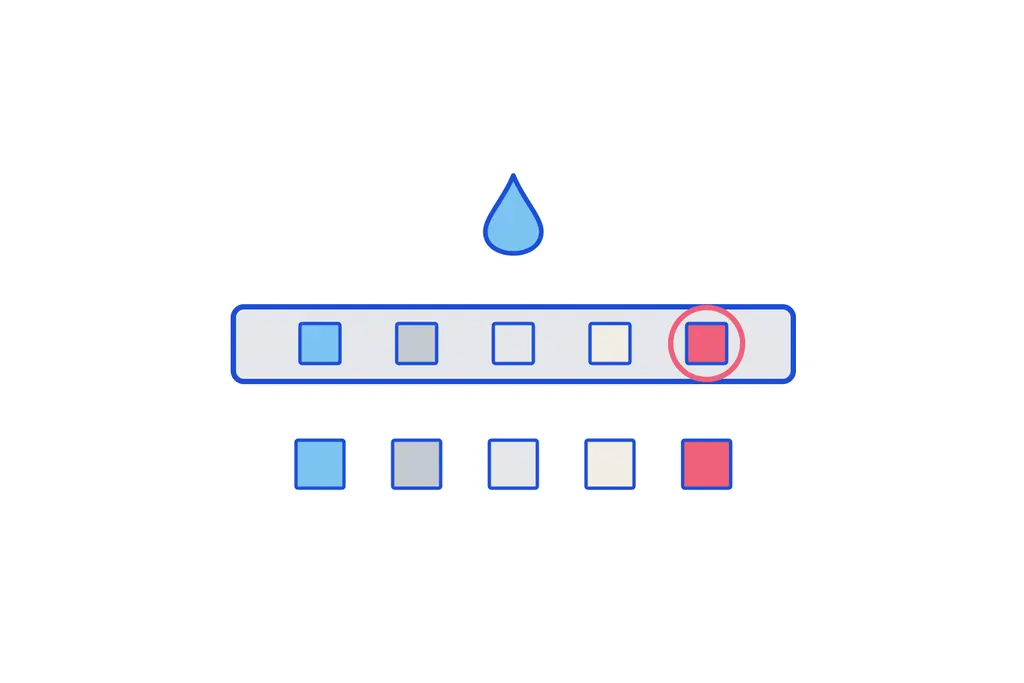
What you read is a step on a color chart, not an exact number. The Industrial Test Systems WaterWorks Total Hardness strip, for example, lists these color steps: “0, 40, 80, 120, 180, 250, 425, 1000 ppm (mg/L).” If your strip lands between 120 and 180, it’s roughly 7–10.5 gpg, and that’s all a strip can tell you. Use a strip as a first check. If the result lands near a line that matters to you, such as 7 gpg, confirm it with a drop kit or a lab.
Drop-count (titration) kits. You add a reagent one drop at a time until the sample changes color, and the count gives the hardness. On Hach’s Model 5-B kit, the sample “turns red/pink if hardness is present,” turns blue at the end point, and the “Number of drops = total hardness (gpg as CaCO₃).” Use exactly the sample size the instructions give, because that’s what makes one drop equal one unit. Read the safety data sheet before you start. LaMotte, for example, marks two reagents in its hardness kit as a “potential health hazard.”
Which strip or kit to buy, with makers’ specs and listed prices, is covered on water hardness test kits.
Lab testing: when it’s worth it
Use a lab when the result will drive a purchase. Penn State Extension recommends having water “tested by an independent lab” before choosing a softener: “Although many water softening companies offer free hardness testing, it’s best to have a third-party evaluation. An independent lab test is not expensive and will protect you from being oversold.” Nebraska Extension: “In situations where considerable investment is necessary to correct a problem, verification of the severity of the problem by an approved laboratory is advisable.” On a well, a lab package can also cover iron, manganese and pH in the same sample (see the last section).
Finding a lab. EPA says to “Only use laboratories that are certified to do drinking water testing.” It points to your state’s certified laboratories and to your local health department, “which may provide private well testing for free.” Lab fees vary. Examples from two state-university labs are on water hardness test kits, and full well panels on well water testing cost.
Taking the sample. Penn State Extension says to get “proper sanitized containers and instructions from the laboratory ahead of time,” and not to use old food or drink containers. Some labs send a kit. Penn State’s own lab says “Kits are available at many county extension offices,” and the filled kit goes back “by overnight mail.” If you already have treatment equipment, a sample from a kitchen faucet “will often be influenced by the treatment equipment.” For raw well water, Penn State suggests “the spigot on the pressure tank before the water enters any water treatment equipment.”
Reading results: gpg, mg/L and ppm
Results come in grains per gallon (gpg) or mg/L, which is the same as ppm, reported “as CaCO₃.” To switch units, use about 17.1 mg/L per gpg: 200 mg/L ÷ 17.1 = 11.7 gpg. The water hardness scale shows what each range is called by Penn State Extension and by USGS. Or type the number into the Water Check, which takes either unit.
Keep the number after you buy. MDH says to “Make sure the softener is set to the hardness of your water supply,” because a setting that’s too high costs more to run and wastes water. Nebraska Extension recommends you “periodically re-test after installation of treatment devices.”
Well owners: test for iron, manganese and pH too
Hardness is only one line on a well test. EPA says: “Test your private well annually for total coliform bacteria, nitrates, total dissolved solids, and pH levels.” In EPA’s chart of reasons to test, “Water softener needed to treat hardness” points to testing for manganese and iron.
Iron matters for the softener itself. Penn State Extension says “Conventional water softeners are sometimes effective for removing iron and small amounts of manganese.” If you’re counting on that, Penn State says softeners are “generally only recommended” for it when the pH is above 6.7, hardness is 3 to 20 gpg and dissolved iron is under 5 mg/L. A home hardness kit can’t check all of that, but a lab package can. See iron filter for well water if iron comes back high.
For anything beyond hardness, test through a state-certified lab and ask your state or local health department what’s common in your area. This site doesn’t give medical advice. For health questions about your water, ask your state or local health department.
Tool
Have a hardness number or a well test? Water Check turns it into what to install, the size and a price range.
Open Water CheckAn AI tool drew the illustrations on this page as simple diagrams. They are not photographs of real homes, water systems, products or people.
Sources
- U.S. EPA — CCR Information for Consumers (updated Nov 21, 2025)
- Minnesota Department of Health — Home Water Softening: Frequently Asked Questions (last updated Oct 3, 2022)
- University of Nebraska–Lincoln Extension — G1491, Drinking Water Treatment: Water Softening (Ion Exchange), Water Testing section (revised Sept 2014)
- Penn State Extension — Water Softening (updated Sep 8, 2025)
- Penn State Extension — Testing Your Drinking Water (updated June 2, 2025)
- Penn State Extension — A Water Quality Toolkit for Greenhouse and Nursery Production, Hardness Testing Tools (updated Oct 13, 2025)
- Penn State Agricultural Analytical Services Lab — Drinking Water Testing, how to submit a sample (checked Nov 1, 2026)
- Industrial Test Systems — WaterWorks Total Hardness Test Strips, Part No. 480008, detection steps (checked Nov 1, 2026)
- Hach — Total Hardness Test Kit, Model 5-B (145300), product page (checked Nov 1, 2026)
- LaMotte — Total Hardness Kit, Code 4482-LI-02, instruction sheet (07.13.2023)
- U.S. EPA — Protect Your Home's Water, private wells (updated Feb 26, 2026)
- Penn State Extension — Iron and Manganese in Private Water Systems (updated May 29, 2025)
Updated 2026-11-01