Lab note
Water Hardness Test Kits: Strips, Drops or a Lab?
Home test kits come in two kinds. Test strips change color and give you a range, such as 120–180 mg/L, in minutes. Drop-count (titration) kits give you a number, with each drop equal to 1 grain per gallon on kits like Hach’s Model 5-B. A lab test costs more per sample but is more reliable, Nebraska Extension says, and it can add iron, manganese and pH in the same sample. A TDS meter estimates all dissolved ions together, not hardness (see below). Strips are fine to check whether you have hard water at all. A drop kit gets you closer than a strip, but before a big purchase, Penn State and Nebraska Extension both point to a lab.
Which kind of test to use
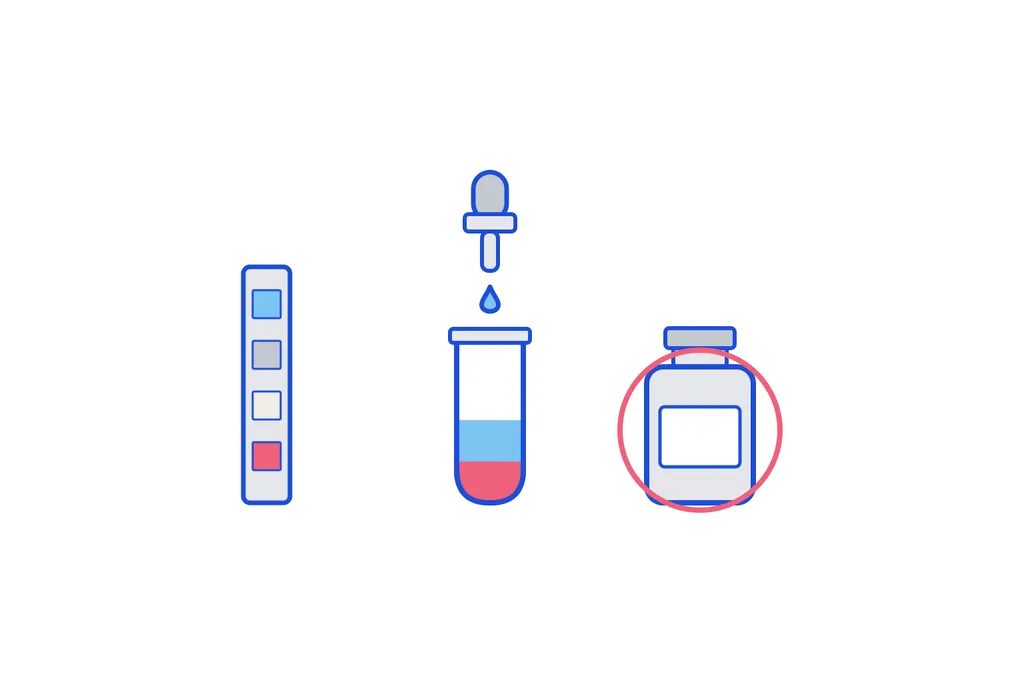
Nebraska Extension’s view of home tests: “While some may provide accurate and reliable measurements from which decisions can be made, others may not. Greater reliability and accuracy can be expected with laboratory testing.” Below, each method’s details come from its maker or from an extension service. We haven’t tested any of these products.
| Method | What you get | Example (maker’s spec) | Price, as listed |
|---|---|---|---|
| Test strips | A color step on a chart | ITS WaterWorks Total Hardness: “0, 40, 80, 120, 180, 250, 425, 1000 ppm (mg/L),” 50 tests | $10.49 on Industrial Test Systems’ site (regular price, no sale shown; checked Nov 1, 2026). Penn State Extension: about $15 for 50 strips |
| Drop-count titration kit | A count of drops = hardness | Hach Model 5-B: “1 drop = 1 gpg (or 17.1 mg/L as CaCO₃),” 1–30 gpg, about 100 tests | Hach: “Price: Contact Us.” Penn State Extension: about $40 for a kit with reagents for 50 tests |
| Multi-test case kit | Hardness plus other readings | Pro Products 2401: hardness, iron and pH | $149.98 on DiscountFilterStore’s site (regular price, no sale shown; checked Nov 1, 2026) |
| Lab test | A reported number, plus other tests if you order them | Penn State lab, hardness alone; UGA Coweta County basic test (pH, hardness, metals) | $20 plus overnight shipping (Penn State); $23 (UGA Coweta County) |
Penn State’s two price estimates come from its toolkit for greenhouse and nursery growers. They’re for the same kinds of tests, not for drinking-water kits specifically.
Test strips
Penn State Extension describes the method: hardness strips “measure hardness in mg/L by dipping the test strip into a water sample and then waiting for a color change to compare to a provided chart.” Hach’s strips (2745250) read 0–425 mg/L, 50 tests to a pack. ITS’s strip goes to 1,000 ppm.
What to check on the label:
- The steps. A strip reads in steps, not a smooth scale. ITS’s steps of 120 and 180 ppm sit on the edges of the “hard” class (7–10.5 gpg) on the Penn State scale. That makes it easy to see which class you’re in, but not where you are within it.
- Units. Penn State says strips read hardness in mg/L, and both strips here do. Divide by 17.1 for gpg.
- Storage. Penn State advises keeping test strips “protected from sunlight, temperature and humidity extremes, and dust.”
Drop-count (titration) kits
You add drops of a reagent until the color changes and count them. On the Hach 5-B, the sample “turns red/pink if hardness is present” and you count drops until it turns blue. “Number of drops = total hardness (gpg as CaCO₃).”
What to check:
- What one drop equals. On the Hach 5-B it’s 1 gpg. LaMotte’s dropper kit (4482-LI-02) lets you choose. Its instruction sheet gives three fill lines on the tube: “1 drop = 10 ppm,” “1 drop = 1 gpg” or “1 drop = 20 ppm.” Its product page lists only the first two.
- Tests per kit and refills. LaMotte lists “50 at 200 ppm or 20 gpg” and sells a reagent refill. Harder water uses more drops per test, so you get fewer tests.
- Safety data. LaMotte marks two of its reagents as a “potential health hazard” and points to the safety data sheet.
The Pro Products 2401 kit sold by DiscountFilterStore adds iron and pH. Its listing says it uses “colorimetric testing methods” and that it “does not test for bacteria, lead, nitrates, PFAS, or other health-related contaminants.”
Lab tests
A lab is the more reliable option, Nebraska Extension says, and the one Penn State and Nebraska Extension point to before a big purchase. Their reasons, and how to take a sample, are on how to test water hardness. What two state-university labs charge (checked Nov 1, 2026):
| Lab | Test | Fee |
|---|---|---|
| Penn State Agricultural Analytical Services Lab | Hardness, individual analysis | $20 |
| Penn State Agricultural Analytical Services Lab | Aesthetics/Corrosivity package (bacteria, pH, TDS plus hardness, alkalinity, corrosivity index, copper, iron, manganese) | $85 |
| UGA Extension, Coweta County, Georgia | Basic water test (pH, hardness and a list of metals and minerals) | $23 |
Shipping comes on top at Penn State: its lab says the filled kit goes back “by overnight mail.” These are examples from two labs, not national prices. For a private well, EPA says to “Only use laboratories that are certified to do drinking water testing.” Hardness kits don’t screen for health-related contaminants. For those, test through a state-certified lab. This site doesn’t give medical advice. For health questions about your water, ask your state or local health department.
Digital meters: a TDS reading isn’t hardness
If a digital meter reads TDS (total dissolved solids), it isn’t a hardness meter. USGS explains that TDS is “the sum of all the substances, organic and inorganic, dissolved in water,” and that TDS “can be monitored in real time in surface water and groundwater by measuring its surrogate, specific conductance.” That conductance “increases with the amount of dissolved ions in the water.” So a meter that works this way estimates all dissolved ions together, not calcium and magnesium alone. USGS does say “water with high total dissolved solids usually is hard,” but usually isn’t a number you can size a softener with. Penn State’s toolkit lists TDS/EC meters, starting around $20, as a separate tool from its hardness strips and titration kits.
Reading the result in gpg or mg/L
Strip charts usually read in ppm (mg/L); drop kits like the Hach 5-B read in gpg. They convert at about 17.1 mg/L per gpg. A strip that lands on 180 ppm is about 10.5 gpg, and a 12-drop result on a 1-drop-per-gpg kit is 12 gpg, or about 205 mg/L. The water hardness scale shows the classes in both units.
What to do with the number
- Put it into the Water Check for the class and a rough softener size.
- Below 7 gpg, Penn State Extension says hardness “will probably not cause major scaling and soap film.”
- Above 7 gpg or 120 mg/L, the Minnesota Department of Health says “you might need a water softener to ensure your appliances run well.”
- Keep it. MDH says to “Make sure the softener is set to the hardness of your water supply.”
Sizing also depends on how much water you use. See what size water softener do I need.
Tool
Have a hardness number or a well test? Water Check turns it into what to install, the size and a price range.
Open Water CheckAn AI tool drew the illustrations on this page as simple diagrams. They are not photographs of real homes, water systems, products or people.
Sources
- Industrial Test Systems — WaterWorks Total Hardness Test Strips, Part No. 480008, listed price and detection steps (checked Nov 1, 2026)
- Hach — Total Water Hardness Test Strips, 0-425 mg/L, 50 tests (2745250) (checked Nov 1, 2026)
- Hach — Total Hardness Test Kit, Model 5-B (145300) (checked Nov 1, 2026)
- LaMotte — Total Hardness Test Kit (Dropper Bottle Method), 4482-LI-02, product page (checked Nov 1, 2026)
- LaMotte — Total Hardness Kit, Code 4482-LI-02, instruction sheet (07.13.2023)
- DiscountFilterStore — 2401 Pro Products Water Test Kit (Hardness, Iron and pH), listing (checked Nov 1, 2026)
- Penn State Extension — A Water Quality Toolkit for Greenhouse and Nursery Production, Hardness Testing Tools (updated Oct 13, 2025)
- University of Nebraska–Lincoln Extension — G1491, Drinking Water Treatment: Water Softening (Ion Exchange), Water Testing section (revised Sept 2014)
- Penn State Extension — Water Softening (updated Sep 8, 2025)
- Penn State Agricultural Analytical Services Lab — Drinking Water Testing, package and individual fees, sample submission (checked Nov 1, 2026)
- UGA Extension, Coweta County — Testing Services, water tests (checked Nov 1, 2026)
- USGS — Chloride, Salinity, and Dissolved Solids (Mar 1, 2019)
- Minnesota Department of Health — Home Water Softening: Frequently Asked Questions (last updated Oct 3, 2022)
- U.S. EPA — Protect Your Home's Water, private wells (updated Feb 26, 2026)
Updated 2026-11-01