Lab note
Whole House Water Filter for Well Water: What to Test First
No single filter fixes well water. A whole house system for a private well is a set of stages, and which stages you need depends on what a state-certified lab finds in your water. HomeGuide (April 2026) gives the usual order as “sediment filter first, then acid neutralizer (if needed), then iron filter, then water softener, then UV disinfection.” Its text puts the average at $1,500 to $5,000 “including equipment and professional installation,” from as little as $300 for a basic sediment filter to $10,000+ for a multi-stage system (the summary box at the top of the same page says $800 to $5,000). Test first, then buy only the stages your report calls for.
Test before you buy
No agency tests a private well for you automatically, though EPA notes your local health department “may provide private well testing for free.” The U.S. EPA says “Private well owners are responsible for delivering safe drinking water to their households,” and that well water quality is “not regulated by the Federal Government under the Safe Drinking Water Act nor by most state governments and laws.”
The CDC’s yearly baseline is total coliform bacteria, nitrates, total dissolved solids and pH, and it says: “Use a state-certified laboratory to test your water.” A treatment decision needs more. EPA’s checklist for well owners links symptoms to tests:
| What you notice | EPA says to consider testing for |
|---|---|
| Scaly residues, soaps don’t lather | Hardness |
| Stained plumbing fixtures, laundry | Iron, copper, manganese |
| Objectionable taste or smell | Hydrogen sulfide, corrosion, metals |
| Water softener needed to treat hardness | Manganese, iron |
If a dealer offers a free in-home test, Penn State Extension’s advice is: “Confirm home water test results through an independent lab.” Lab prices and package contents are on our well water testing cost page.
Match each lab result to a treatment
| Lab result | Reference level | Treatment types the source names |
|---|---|---|
| Sediment, sand, cloudiness | No number | Sediment filters: “Soil, sand, other particles” (Penn State) |
| Hardness | Above 7 gpg (120 mg/L) “you might need a water softener” (Minnesota Dept. of Health) | Water softener |
| Iron | 0.3 mg/L, EPA secondary standard | Softener (limited), oxidizing filter, oxidation + filtration (Penn State) |
| Manganese | 0.05 mg/L, EPA secondary standard. Health-based: EPA Health Advisory 0.3 mg/L (cited by Penn State); Minnesota: harmful “For babies under one year old” above 100 µg/L, “For everyone else” above 300 µg/L | Same group as iron; test through a state-certified lab and ask your health department |
| Hydrogen sulfide (rotten-egg smell) | No drinking water standard (Penn State) | Carbon, oxidizing filter, chlorination + filtration |
| pH | 6.5–8.5, EPA secondary standard | Acid neutralization for low pH (Penn State) |
| Coliform bacteria | Minnesota: harmful if “Any coliform bacteria are detected” | Ask your health department first (see below) |
| Nitrate, arsenic, lead | Health-based levels: ask your state health department (Minnesota, for example: nitrate “above 10 mg/L”) | Ask your health department first (see below) |
EPA’s secondary standards are non-mandatory guidelines for public water systems “for aesthetic considerations, such as taste, color, and odor”; here they serve as reference points. Details: iron filter for well water, sulfur smell in well water.
Bacteria, nitrate, arsenic and other health contaminants are not a filter-shopping question. The CDC says: “If your test results show that there are harmful germs or chemicals in your well water, consider drinking bottled water or another safe source of water,” and to contact your local health or environmental department. After coliform bacteria are found, Minnesota’s health department lists disinfecting “your well and water system with a chlorine solution.” Minnesota names “a licensed well contractor” for this work; this site doesn’t give the steps or amounts. Ask your state or local health department what to do and which lab to use for the retest.
Order of treatment
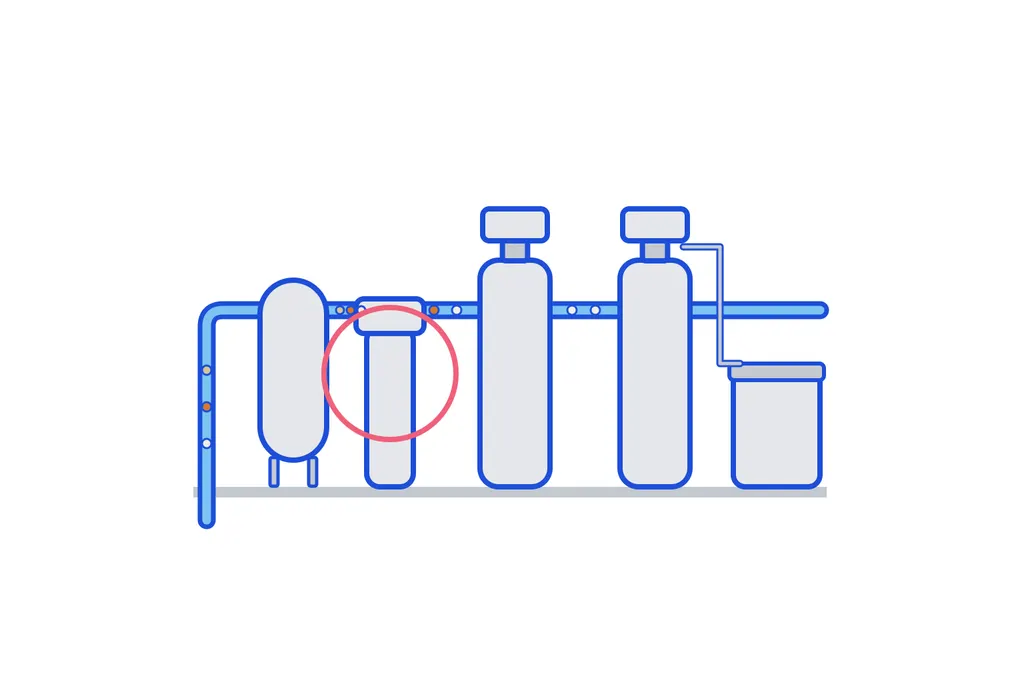
Each stage protects the next one:
- Sediment filter. HomeGuide: “It protects downstream equipment like water softeners, UV lights, and carbon filters from clogging.”
- Acid neutralizer, if pH is low. Penn State: it “Uses limestone chips or soda ash to increase water pH and hardness to prevent corrosion.” Note the added hardness: the softener downstream has to handle it.
- Iron, manganese or sulfur filter. Penn State says oxidized iron and manganese “will foul the softener resin,” and “If oxidized iron and/or manganese are present in the raw water, filtration should be used for removal.” If this stage uses a chlorine feed pump, Penn State says a carbon filter may be needed after the chlorinator and its filter “to remove the objectionable taste and odor from the residual chlorine.”
- Water softener. It handles hardness and, within limits, some dissolved iron. The Water Check tool sizes it from your hardness.
- UV disinfection, if the lab and your health department point to it. Penn State: “Water must be free of sediment to kill bacteria effectively. Bulb must be changed annually.”
System types and what they cost
Two sources, side by side. HomeGuide splits equipment from installed cost. Penn State lists typical prices without saying whether installation is included.
| System | HomeGuide equipment (Apr 2026) | HomeGuide installed (Apr 2026) | Penn State Extension (Jul 2026) |
|---|---|---|---|
| Sediment filter | $50–$300 | $150–$500 | — |
| Whole-house carbon | $300–$1,000 | $600–$2,000 | $500–$1,500* |
| Iron/manganese filter | $500–$2,500 | $1,000–$3,500 | $500–$1,500* (oxidizing filters) |
| Water softener | $500–$2,500 | $1,000–$3,500 | $500–$1,500* |
| UV disinfection | $400–$1,500 | $700–$2,500 | from $400 to more than $1,000 |
| Multi-stage whole-house | $1,500–$5,000 | $2,500–$10,000+ | — |
* Penn State: “Most larger, whole-house point-of-entry (POE) filters” cost $500 to $1,500.
HomeGuide’s example of a typical setup is a sediment filter, iron removal system, water softener and an under-sink RO system, “with a combined installed cost of $3,000 to $7,000.” Fixr (January 2025) puts a combined “water softener and filter system” at $1,500 to $10,000 installed (Fixr’s figure isn’t specific to wells).
HomeGuide’s softener figures are for well water. For softeners in general, Fixr gives $1,100 to $3,000 installed, “with most homeowners spending $2,500 to install a dual-tank ion exchange system for a 3 to 4-bedroom home”; see water softener cost.
HomeGuide lists two extras: a drain connection for units that backwash, “which adds cost if one isn’t nearby” ($100–$300), and “a dedicated electrical outlet” for UV systems and chemical feed pumps ($100–$400). Installation belongs to a licensed plumber, plus a licensed electrician if a new outlet or circuit is needed. Ask whether your town requires a permit.
Sizing for flow rate
HomeGuide: “A two-bathroom home typically needs 7 to 10 GPM, while a four-bathroom home may require 12 to 15 GPM or more.” With several stages, it says to “make sure your well pump and pressure tank can handle the additional load.”
Ask the dealer for each unit’s rated service flow in gpm, and the flow it needs to backwash. Then ask your well contractor whether your pump delivers it.
Maintenance
“All water treatment equipment requires routine maintenance,” says Penn State. HomeGuide’s maintenance table for well systems includes:
| Task | How often | Cost (HomeGuide) |
|---|---|---|
| Sediment cartridge | Every 1 to 3 months | $5–$30 each |
| Iron filter media | Every 5 to 10 years | $200–$600 |
| UV lamp | Annually | $50–$150 |
HomeGuide puts total annual maintenance at $100 to $500. After installation, Minnesota’s health department says to “test the treated water to make sure the treatment is working.”
What to ask the dealer or plumber
- Which certification covers my contaminant? NSF/ANSI 42 covers aesthetic impurities “such as chlorine and taste/odor,” 53 covers “a contaminant with a health effect,” 44 covers softeners, 55 covers UV (Class A systems are for “contaminated water”), and 58 covers reverse osmosis. NSF adds that certification “does not mean that a filter, purifier or treatment system will reduce all possible contaminants.” Penn State: “Ask water treatment vendors to provide written proof of these certifications.”
- Who installs it? A licensed plumber (Minnesota also names a licensed water conditioning contractor), and is a permit needed?
- Who maintains it, and what’s the warranty? Get both in writing.
This site doesn’t give medical advice. For health questions about your water, ask your state or local health department.
Tool
Have a hardness number or a well test? Water Check turns it into what to install, the size and a price range.
Open Water CheckAn AI tool drew the illustrations on this page as simple diagrams. They are not photographs of real homes, water systems, products or people.
Sources
- U.S. EPA — Private Drinking Water Wells (accessed Nov 1, 2026)
- U.S. EPA — Protect Your Home's Water (last updated Feb 26, 2026)
- U.S. EPA — Secondary Drinking Water Standards: Guidance for Nuisance Chemicals (last updated May 26, 2026)
- CDC — Guidelines for Testing Well Water (July 1, 2024)
- CDC — Guidelines for Treating Well Water (July 2, 2024)
- Minnesota Department of Health — Well Testing, Results, and Options (last updated Oct 19, 2026)
- Minnesota Department of Health — Home Water Softening FAQ (last updated Oct 3, 2022)
- Minnesota Department of Health — Home Water Treatment Facts (last updated Aug 15, 2024)
- Penn State Extension — Tips for Buying Water Treatment Equipment (updated July 1, 2026)
- Penn State Extension — Iron and Manganese in Private Water Systems (updated May 29, 2025)
- Penn State Extension — Hydrogen Sulfide (Rotten Egg Odor) in Water Wells (updated Dec 10, 2024)
- NSF — NSF Standards for Water Treatment Systems (accessed Nov 1, 2026)
- HomeGuide — How Much Does a Well Water Filtration System Cost? (Apr 24, 2026)
- Fixr — Water Softener Installation Cost, average cost and section "Whole-House Water Filter and Softener System" (updated Jan 31, 2025)
Updated 2026-11-01